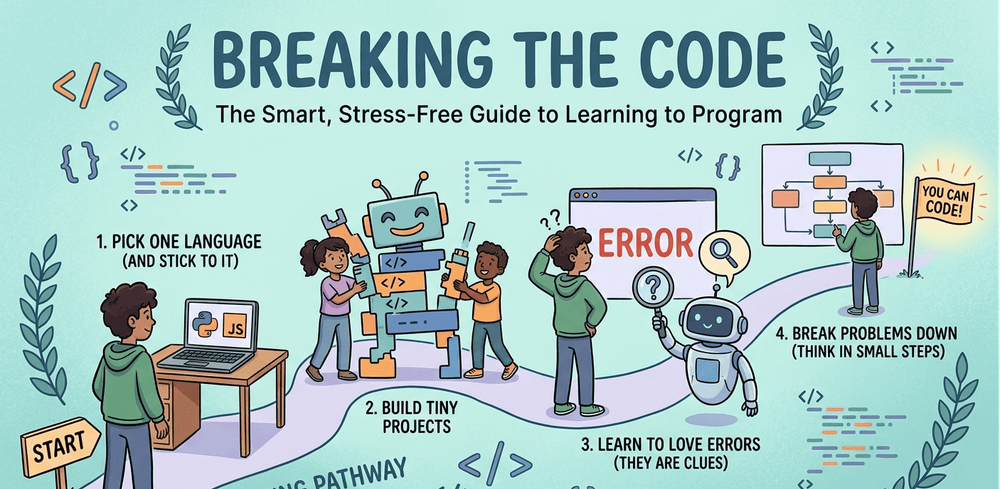
Here is the secret: programming isn’t about being a math genius or memorizing endless lines of code. Programming is just the art of breaking big problems down into small, logical steps.
Whether you want to automate a boring spreadsheet at work, build your own mobile app, or start a new career path, learning to code is completely achievable. You just need the right roadmap. Let's look at how to get started without the overwhelm.
1. Pick One Language (And Stop Looking at the Others)
The biggest mistake beginners make is trying to learn everything at once. They bounce from Python to JavaScript to C++ because they are worried about picking the "wrong" one.Think of programming languages like driving cars. Once you learn how to steer, brake, and navigate a road in a Honda, you can drive a Ford or a BMW without starting from scratch. The core logic—loops, variables, and conditionals—is nearly identical across most languages.
If you don't know where to start, pick one of these two entry points:
Choose Python if: You want something easy to read (it looks a lot like plain English). It is the king of data analysis, artificial intelligence, and automating daily tasks.
Choose JavaScript if: You want to build things people can see and interact with online. It is the language that powers the entire interactive web.
2. Shift from "Reading" to "Building" Immediate Projects
You cannot learn to code just by reading books or watching someone else do it on YouTube. It feels like you’re learning, but it’s a trap. The moment you close the video, you realize you have no idea what to type on your own blank screen.The solution is to build tiny, imperfect things immediately.
Instead of just learning what a "variable" is, use it to write a program that asks for your name and calculates how many days old you are.
Instead of memorizing a list of functions, try building a basic rock-paper-scissors game that prints the winner to the screen.
When you build projects, you are forced to figure out why things work. More importantly, you'll learn how to deal with errors.
3. Learn to Love the Errors (They Aren't a Sign of Failure)
When a program crashes and throws a terrifying red error message on the screen, a beginner's instinct is to think, "I'm bad at this."An experienced developer looks at that same red text and thinks, "Awesome, the computer is telling me exactly where the problem is."
The Developer Reality: Professional software developers spend a huge chunk of their day fixing broken code. Programming is fundamentally a loop of writing code, breaking it, reading the error message, fixing it, and moving to the next step.
Get comfortable copying your error messages, pasting them into a search engine, and reading how other people fixed them on sites like Stack Overflow. It isn't cheating; it's the job.
4. Think in Small Steps (The "Sandwich" Analogy)
Computers are incredibly fast, but they are also profoundly literal. They only do exactly what you tell them to do. Learning to program means learning to express instructions with clarity.Think about giving a robot instructions to make a peanut butter sandwich. If you say, "Put peanut butter on the bread," the robot might slam the unopened jar onto the loaf. You have to tell it to pick up the knife, open the jar, dip the knife, and spread it.
When you sit down to write a piece of code, write it out in plain English (we call this pseudocode) first. If you can't explain the steps to a human, you won't be able to code it for a computer.
Your First Step Today
You don't need a fancy computer, an expensive boot camp, or a computer science degree to start. Some of the best learning platforms are completely free.If you want to write your first line of code today, pick an interactive platform that lets you type code directly into your browser without installing anything complicated. Websites like freeCodeCamp, Codecademy, or Scrimba will give you immediate, hands-on practice.
Consistency beats intensity every single time. Spending twenty minutes a day coding will get you much further than trying to cram an eight-hour session once every weekend. Take it one line at a time!
Comments