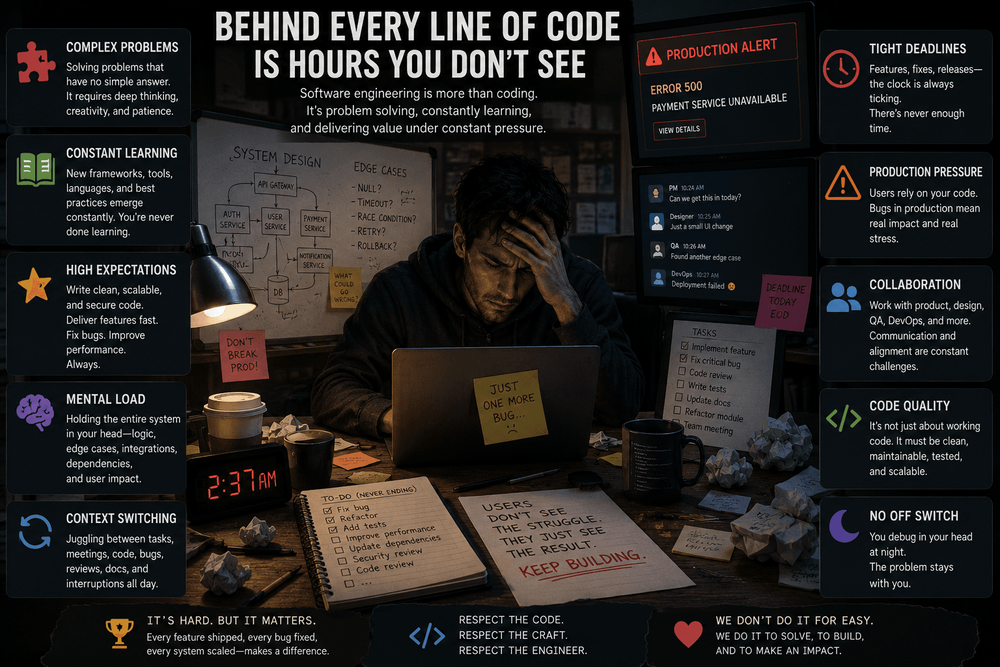
But they don’t see the struggle. They don’t see the wreckage of crushed deadlines, the crushing weight of hidden system architecture, or the phantom ring of an alert system firing at 2:37 AM. Behind every elegant user experience lies a chaotic world of unseen problem-solving, constant cognitive load, and relentless professional pressure. Software engineering is so much more than writing code—it is delivering value under non-stop pressure.
1. The Invisible Mental Load & System Complexity
Coding is rarely about typing syntax; it is about building complex, abstract skyscrapers inside your head. Before a single character is written, an engineer must hold the entire structural reality of an ecosystem in their mind. This includes complex logic loops, unhandled edge cases, downstream service dependencies, API gateways, database integrity, and direct user impact.When a feature breaks, it is rarely due to a simple typo. It is usually because a tiny change in an Auth Service sent an unexpected null payload cascading into a Notification Service, knocking out database connections downstream. Mapping these massive, invisible webs of logic requires deep thinking, boundless creativity, and an extreme level of mental endurance.
2. The Relentless "Context Switching" Carousel
In an ideal world, an engineer spends their day focusing deeply on a single problem. In reality, a software engineer is a professional plate-spinner. Throughout any given shift, a developer is routinely dragged across jarring context shifts that break concentration:10:24 AM (Product Manager): "Can we get this major feature shipped by EOD today?"
10:25 AM (UI Designer): "Just a small layout change—it shouldn't take more than five minutes."
10:26 AM (QA Analyst): "Found another edge case regarding simultaneous retry requests."
10:27 AM (DevOps Engineer): "The latest deployment pipeline just failed. Rollback initiated."
Juggling writing code, reviewing peer pull requests, jumping into unexpected debugging fire drills, writing clear technical documentation, and managing stakeholder expectations shatters deep focus. Every single switch incurs a heavy cognitive cost, leaving engineers exhausted before the "real" coding even begins.
3. The Pressure Cooker: Deadlines and Production Alerts
Software engineers build infrastructure that real businesses and actual human beings rely on hourly. When code fails, the consequences aren’t theoretical—they are tangible.PRODUCTION ALERT | ERROR 500: PAYMENT SERVICE UNAVAILABLE
A bug in production doesn't mean a bad grade; it means a payment portal goes dark, costing a business real money, impacting real users, and inducing absolute panic across corporate communication channels.
This reality creates a persistent underlying tension. Deadlines are consistently aggressive, driven by commercial needs. Features, bug fixes, and infrastructure patches are constantly stacked up against a ticking clock. Yet, cutting corners to hit a deadline risks introducing bugs into live production environments, transforming an evening of rest into a desperate firefighting session.
4. The Reality of the "No Off Switch"
Perhaps the most exhausting aspect of software engineering is that problems do not stay at the office desk. Code has a unique way of occupying the subconscious mind. It is a common trope among developers because it is painfully true: you will spend five hours staring fruitlessly at a bug during the day, only to solve it in your head while lying wide awake in bed at midnight or standing in the shower.Because technology never sleeps, and frameworks evolve at a breakneck pace, engineers are locked into a cycle of constant learning. The language, tool, or library mastered last year is deprecated next year. You are never truly "done" learning, and the intellectual problem-solving loop rarely shuts off completely.
Conclusion: Why it Matters
It’s hard. But it matters.
Every single feature shipped, every critical bug fixed, and every system scaled makes a measurable difference in the modern world. Software engineers don't do it because it's easy. They do it to solve, to build, and to make an impact.
The next time you open an app and it works flawlessly, remember the developer who stared at a screen at 2:37 AM whispering, "Just one more bug..."
Comments